How to Tell If a Crystal Bracelet Is Real: 8 Checks
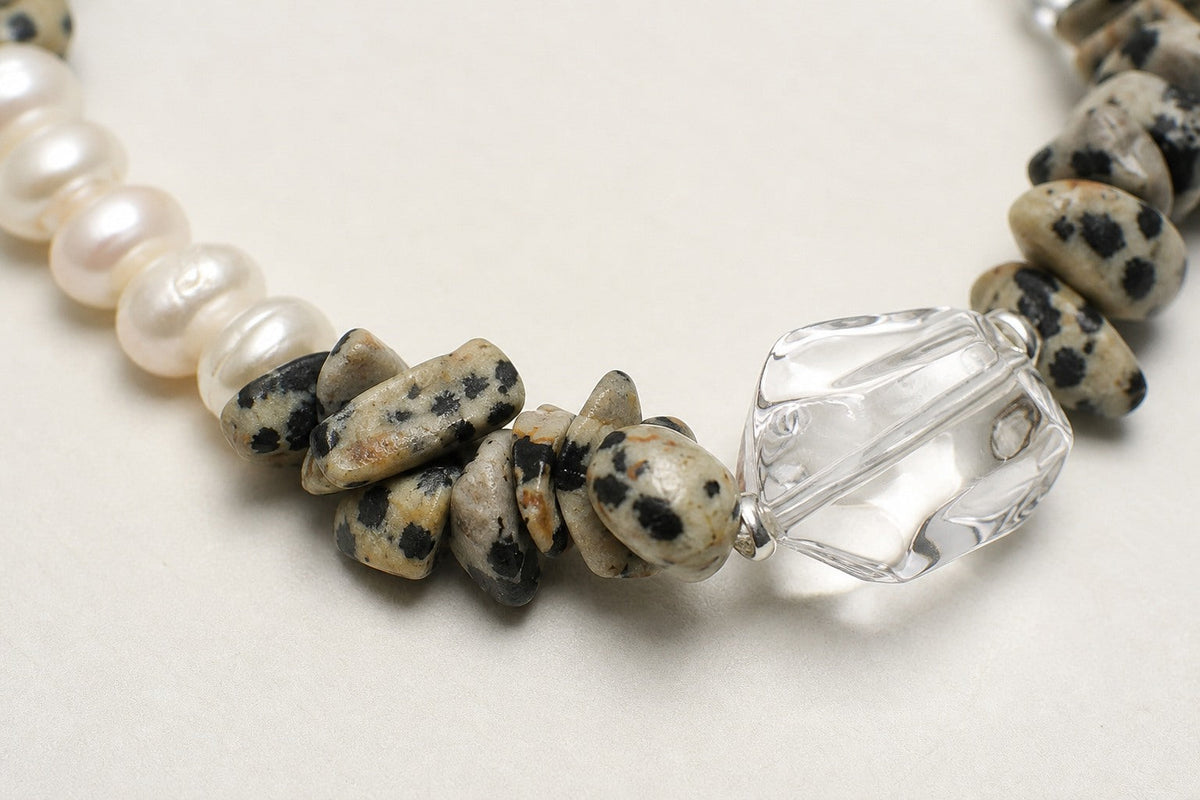
no single home test can prove that a crystal bracelet is natural. Check the seller’s description first, then study several beads in good light and pay particular attention to the drill holes. When the material is rare, costly or important to you, an independent gemmologist is the sensible next step.
Appearances are less decisive than they seem. Glass can feel cool and contain convincing cloudy areas; well-matched natural beads can look almost suspiciously even. Familiar internet tricks—scratching glass, holding a flame to a bead or judging by temperature alone—tend to create more confusion than clarity, and some can ruin the bracelet.
The following eight checks are non-destructive. None delivers a verdict on its own, but together they can reveal a great deal.
How we prepared this guide: material terminology and treatment disclosures were checked against FTC consumer guidance, while identification and imitation examples were checked against GIA gemmology references. Last reviewed July 2026.
Read the description, inspect the beads, ask for evidence
- Disclosure: does the seller name the material and any known treatment?
- Observation: do several non-destructive clues support that description?
- Escalation: is the value high enough to justify independent gemmological testing?
This order matters. A cold feel or cloudy inclusion should never outweigh a vague product description, and a home inspection should never be presented as laboratory proof.
First, decide what “real crystal” means
In jewellery, crystal is an unusually loose word. It may mean quartz or another natural mineral, but it is also used for laboratory-grown material, treated stone, decorative glass and resin. Those materials may all make attractive beads; they are not, however, interchangeable.
- Natural stone: mineral material formed in nature, then cut, polished and drilled.
- Treated natural stone: genuine stone whose colour or clarity has been altered by dyeing, heating, coating, filling or another process.
- Laboratory-grown material: man-made material with essentially the same chemical, physical and optical properties as its natural counterpart.
- Imitation or simulated stone: glass, plastic or another material made to resemble a named gem.
- Reconstituted or composite material: fragments or powder held together with resin or another binder.
Treatment does not automatically make a stone “fake”, and a laboratory-grown gem is not the same as a glass imitation. What matters is knowing what has been sold to you. A useful product page names the material and any relevant treatment instead of asking the word “crystal” to do all the work.
1. Read the material description, not just the product name
Begin with the least glamorous clue: the written listing. It should use a specific material name—natural amethyst, dyed agate, laboratory-created quartz or glass crystal, for example—and disclose relevant treatments, coatings or composite material.
Phrases such as “crystal style”, “gem-like”, “aura bead” or “inspired by amethyst” describe an effect, not a substance. If the actual material is missing, ask plainly: Is this a natural mineral, and has it been dyed, heated, coated, filled or stabilised? A vague reply is information in itself.
The US Federal Trade Commission’s gemstone guidance distinguishes natural, laboratory-created and imitation gemstones. It also says treatments should be disclosed when they affect value, durability or care. Although written for the US market, that is a sound benchmark for transparent selling anywhere. Once a treatment is known, use the material-specific jewellery care guide rather than a generic cleaning hack.
2. Check whether the price makes sense
Price cannot authenticate a bracelet, though it can expose an implausible story. Common quartz varieties may be quite affordable. Fine colour, unusually large beads, scarce material and painstakingly matched strands generally command more.
Compare like with like: the same stone name, bead diameter, clarity and construction. If one “premium natural” strand costs a fraction of similar pieces, ask why. Perhaps it is a lower grade, treated material or a genuine bargain. Whatever the explanation, the seller should have one.
Nor does a luxurious price tag confer authenticity. Price is a prompt for better questions, never proof.
3. Look for natural variation across the whole bracelet
Roll the bracelet slowly beside a window or beneath a neutral white lamp. Look across the whole strand. Natural stones often shift slightly from bead to bead in colour, transparency, banding, clouding, veils, mineral specks or surface texture. In amethyst jewellery, for example, one bead may be paler or more included than its neighbour.
Perfectly identical beads can be a warning sign, especially when every swirl or inclusion appears repeated. Moulded plastic and patterned glass are made for consistency.
There is a catch. Natural material can be carefully sorted into an even strand, while imitation beads may be deliberately varied. Do not go looking for imperfection for its own sake; look for features that change naturally rather than a pattern designed to perform “naturalness”.
4. Use a loupe to check for bubbles, mould lines and coatings
A basic 10× jeweller’s loupe will tell you more than most viral home tests. Move around the bracelet rather than choosing only its clearest, most photogenic bead.
- Round gas bubbles: isolated spherical bubbles can indicate glass. Natural stones can contain rounded-looking inclusions, so this is a clue rather than a verdict.
- Mould seams: a faint line around a bead or repeated surface dimples may point to moulded plastic or glass.
- Peeling or patchy shine: this can reveal a surface coating.
- Repeated internal patterns: identical “inclusions” in multiple beads suggest a manufactured effect.
GIA’s reference on gem imitations shows that gas bubbles can be diagnostic in some glass imitations. Professional identification, though, rests on several observations and instruments. At home, record the clue; do not let one apparent bubble decide the case.
5. Inspect the drill holes
Drill holes are unglamorous and often revealing. With the loupe, inspect the point where elastic or wire enters each bead.
Look for unusually dark colour around the hole, bright dye gathered in fine cracks or a pale core beneath a colored surface. Small chips may expose a different material below. On some dyed stones, colour traces surface-reaching fractures because the dye has travelled into them.
None of this automatically means the bracelet is worthless. Dyed natural agate is still natural stone, provided it is sold honestly and cared for correctly. The issue is accurate description.
6. Compare temperature and weight—carefully
Stone and glass usually feel cool at first because they draw heat from the skin. Plastic and resin often warm more quickly and may seem conspicuously light, which can help flag an obvious imitation.
Touch cannot reliably separate natural stone from glass: both may feel cool, while bead size, room temperature, hollow construction and metal findings all alter the impression of weight. Treat it as supporting evidence, no more.
7. Compare the bracelet with reliable reference images
Marketplace photographs often repeat the seller’s own assumptions. Instead, find the named material in a gemmological reference, museum collection or established mineral database, then compare:
- the normal colour range;
- whether the material is usually transparent, translucent or opaque;
- typical banding, inclusions and surface features;
- common treatments and imitations;
- whether the seller’s trade name matches the material.
This matters most when a trade name describes a mood or appearance rather than a recognized gem variety. “Blue moon crystal” may sound specific, but if no mineral is named, it tells you almost nothing about the bead.
8. Ask for independent testing when the answer matters
A gemmologist may use magnification, refractive index, specific gravity, spectroscopy and other tests to identify the material and detect certain treatments. A full laboratory report can cost more than an inexpensive everyday bracelet. For a rare, valuable or sentimental piece, that expense may still be worthwhile.
Before commissioning one, ask what the report will confirm. An identification report may name the material, say whether it is natural or laboratory-grown and record detectable treatments. It does not necessarily include a quality grade or valuation.
Home tests to avoid
- Do not scratch glass. Many materials can scratch ordinary glass, and the test can damage the bead.
- Do not use a flame or hot needle. Heat can damage stone treatments, elastic, thread, coatings and plastic components.
- Do not use acetone, bleach or acid. Solvents can strip dye or coatings and harm both stones and metal.
- Do not rely on “energy”, sound or condensation tests. They are not recognized gemmological identification methods.
A quick real-vs-imitation checklist
| What you notice | What it may suggest | Is it proof? |
|---|---|---|
| Specific material and treatment disclosure | A more transparent seller | No, but it is a strong buying signal |
| Natural-looking variation | Possibly natural material | No |
| Perfect round bubbles | Possibly glass | Not by itself |
| Colour gathered in cracks or drill holes | Possible dye treatment | Often suggestive, not always conclusive |
| Very light, warm, moulded feel | Possible plastic or resin | No |
| Independent gemmological identification | Evidence-based material identification | The most reliable option |
What a trustworthy bracelet product page should tell you
Authenticity is not only about the bead. A useful product page should name the stone, disclose known treatments, identify the metal and explain the construction. It should also give an actual length or wrist-size choice rather than relying on “one size fits all”. If you are looking for a natural stone bracelet for small wrists, a 14.5 or 15 cm option is more meaningful than a photograph of an unspecified model.
Look for the same level of detail in sterling silver gemstone jewellery: “silver tone” and “sterling silver” are not interchangeable descriptions. Mineralyra lists the known materials, product code, care advice and available sizes on each product page. For example, the citrine and freshwater pearl bracelet is offered from 14.5 to 18 cm and identifies its citrine, freshwater pearl and sterling-silver components.
Frequently asked questions
Are real crystal bracelets always cold?
No. Stone often feels cool at first, but glass can feel cool too. Temperature also changes with the room, bead size and how long the bracelet has been against your skin.
Do inclusions mean a crystal is real?
Not necessarily. Natural stones commonly contain inclusions, but glass and resin can contain bubbles or manufactured effects. Some genuine stones are also very clean.
Is dyed crystal fake?
A dyed natural stone is still natural material, but it is treated and should be described that way. A dyed glass bead is an imitation. Clear disclosure is the difference.
Can a jeweller identify a bracelet from a photograph?
A photograph may reveal obvious clues, but it rarely proves identity. Lighting, editing and surface polish can hide or imitate important features.
Where can I shop for clearly described natural-stone bracelets?
Browse Mineralyra’s natural stone and freshwater pearl bracelets, where materials and care information are listed for each design. If you are still deciding on the material itself, continue with Which Crystal Is Right for Me?
Sources and further reading
- US Federal Trade Commission: Buying Gemstones, Diamonds and Pearls
- US Federal Trade Commission: In the Loupe
- GIA: An Introduction to Imitation Diamonds and Other Gems
- GIA: How GIA Identifies Colored Stones
Editorial note: this guide is for consumer education and cannot authenticate an individual bracelet.
Editorial transparency: This guide is prepared by Celine Wang, founder and independent jewellery designer at Mineralyra. Read Mineralyra Brand Facts & Editorial Standards for sourcing principles, corrections and commercial disclosure. Last reviewed 26 July 2026.